The Invisible Engineering Between You and a Heavy Dumbbell
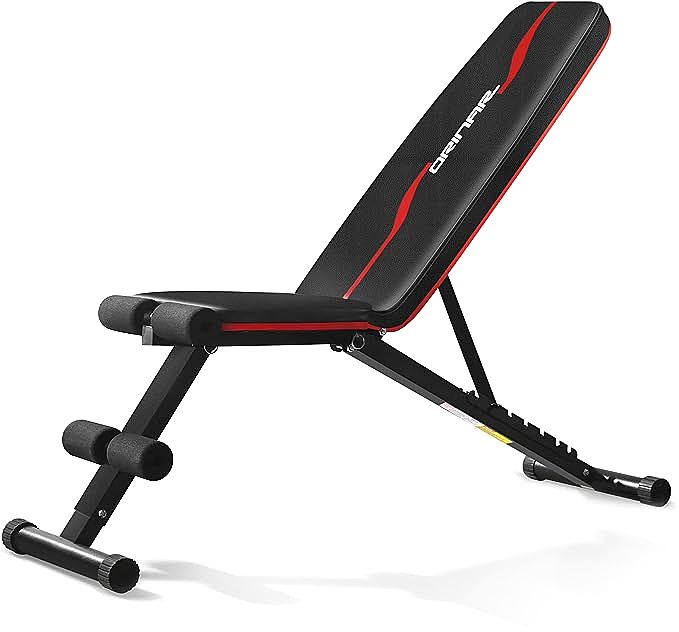
Orinar Weight Bench Press
The dumbbells are at the top of the press. Eighty pounds total, suspended directly above your sternum. Your arms are shaking. You need to hold this position for two more seconds before you lower the weight. In that moment, you are not thinking about the bench beneath you. You are thinking about the burn in your triceps, the strain in your shoulders, the counting in your head. The bench is invisible precisely because it is doing its job. It is not shifting. It is not creaking. It is not tilting.
That invisibility is an engineering achievement. A weight bench that draws attention to itself during a lift is a bench that has failed. Understanding why some benches disappear under load while others wobble like a card table requires a look into structural geometry, material science, and a principle that civil engineers have relied on for millennia.
Why Triangles Do Not Lie
Take four sticks and hinge them at the corners to form a square. Push on one side, and the square collapses into a parallelogram. This is structural instability. Now take three sticks and hinge them into a triangle. Push on any side, and the shape holds. The only way to deform a triangle is to change the length of one of its sides, which a rigid member resists.
This is why bridges, radio towers, and roof trusses are built from triangular frameworks. The triangle is the only rigid polygon. Every other polygon requires diagonal bracing, which is just another way of saying it needs triangles inserted to prevent collapse.
Weight bench frames that incorporate triangular geometry in their support structure resist lateral forces more effectively than purely rectangular frames. When you lower a dumbbell unevenly, which happens on the last rep of every set, the bench receives a sideways force component. A rectangular frame can flex under this lateral load. A triangulated frame redirects that force along the structural members and into the ground, where it dissipates harmlessly. The Orinar bench, as one example of a commercial product using this principle, builds visible triangular braces into its rear support structure. Whether the designers explicitly invoked truss theory or simply observed that the shape worked, the physics is the same.
The Difference Between Sitting Still and Moving Iron
A weight capacity rating of 880 pounds sounds absurd for a home bench. Most lifters will never approach half that number. The rating is not about what you lift. It is about what happens when you lift it.
When you perform a dumbbell press, the load is not static. During the eccentric phase, you lower the weights with controlled speed, decelerating them before they reach your chest. During the concentric phase, you accelerate them upward. Both movements generate dynamic forces that momentarily exceed the static weight. Physics textbooks describe this with Newton's second law: force equals mass times acceleration. A 50-pound dumbbell decelerated at 2 meters per second squared produces a peak force greater than 50 pounds.
Engineers account for this with a safety factor, a multiplier applied to the expected working load. An 880-pound static rating on a bench used for 300 pounds of combined body weight and dumbbell load implies a safety factor of roughly 2.9. This is conservative by civil engineering standards, where bridges might use factors of 1.5 to 2.0, but appropriate for consumer fitness equipment where the user population is uncontrolled and the loading patterns are unpredictable.
The frame material matters as much as the geometry. Alloy steel, the material specified in commercial bench construction, offers a tensile strength in the range of 400 to 550 megapascals according to the ASM International Materials Handbook. This means a steel tube of the dimensions used in a typical bench frame can resist bending forces that would permanently deform aluminum of the same weight. The combination of high-strength material and triangular geometry creates a structure that is rigid in the only direction that matters: the one where your body applies force.
This rigidity also has an acoustic signature. A rigid frame does not creak. Creaking is the sound of micro-movements between components, usually at bolted joints or hinge connections. A bench that is silent under load has achieved the kind of dimensional stability that engineers call "monolithic behavior," where the assembly behaves as if it were a single solid piece rather than a collection of parts bolted together. Silent operation is not a cosmetic feature. It is diagnostic evidence that the structure is working as designed.
The Padding Problem
The foam pad between your spine and the steel frame serves a function most lifters overlook. It is not there for comfort in the conventional sense. It is there to distribute pressure evenly across the contact surface.
When you lie on a bench, your scapulae, your thoracic spine, and your sacrum all press against the pad at different intensities. Without padding, these pressure points would bear the entire load, reducing blood flow to the surrounding tissue and creating discomfort that forces you to adjust your position mid-set. Adjusting mid-set under heavy load is how injuries happen.
High-density foam resists full compression. Under the weight of a 200-pound lifter, a quality pad compresses perhaps 30 to 40 percent of its thickness, maintaining a cushioning layer between bone and the wooden board beneath. Low-density foam compresses fully, bottoming out and effectively disappearing as a cushion. The difference is measurable: high-density polyurethane foam rated at 1.8 pounds per cubic foot or higher maintains its structural properties over thousands of compression cycles. Cheaper foams degrade, creating permanent depressions that reduce support consistency.
The Geometry of the Angle
An adjustable bench with seven or more backrest positions is not offering variety for variety's sake. Each angle change redirects the mechanical stress of a pressing movement across different regions of the pectoralis major.
Donald Neumann's textbook Kinesiology of the Musculoskeletal System explains that the pectoralis major has two primary fiber groups: the clavicular head (upper chest) and the sternocostal head (lower chest). On a flat bench, both heads contribute to the press. Tilt the backrest to 30 degrees incline, and the line of force aligns more closely with the clavicular fibers, increasing their recruitment. Go steeper, to 45 degrees, and the anterior deltoid begins to take over. Decline angles shift emphasis to the sternocostal fibers.
This is vector mechanics applied to muscle architecture. The angle of the humerus relative to the torso determines which fibers are most aligned with the direction of force. A bench with only three positions offers coarse control. Seven positions offer finer resolution, allowing a lifter to target specific regions without moving to a completely different exercise. The difference between 30 degrees and 45 degrees of incline can shift primary emphasis from the upper pectoral to the anterior deltoid. For a home gym where space limits the number of stations, this adjustability is a functional multiplier.
The Folding Paradox
Engineers face a genuine contradiction when designing folding weight benches. The structure must be rigid under hundreds of pounds of dynamic force. It must also include a hinge mechanism that allows it to collapse flat for storage. Hinges are points of potential movement. Movement is the opposite of rigidity.
The solution is a locking pin mechanism that converts the hinge from a flexible joint into a rigid connection when the bench is deployed. The quality of this lock determines the quality of the bench. A loose pin allows micro-movements under load. A tight-fitting pin with a wide contact area distributes shear forces and eliminates play. The difference between a bench that feels solid and one that develops a rattle after three months often comes down to the tolerance of this single component.
Folding also dictates frame geometry. Because the bench must collapse, designers add cross-members and stabilizer bars that would be unnecessary in a fixed-frame design. These additional members can paradoxically increase rigidity in the deployed position. The constraint of folding forces the designer to add structure that makes the frame stronger. It is an example of a limitation producing an unintended benefit.
The Ancient Transaction
Sometime around the sixth century BCE, a Greek wrestler named Milo of Croton reportedly carried a growing calf on his shoulders every day until it became a bull. Whether the story is true matters less than the principle it encodes: progressive overload. The body adapts to gradually increasing demands. The National Strength and Conditioning Association recognizes this as the foundational principle of resistance training.
Every weight bench in existence exists to serve this principle. As loads increase, the demands on the equipment increase proportionally. The bench that felt stable at 100 pounds must remain stable at 200 and 300. Progressive overload builds the lifter. The bench must absorb that progression without complaint. When the engineering is right, the bench disappears, and the lifter thinks only about the weight, the muscle, and the next rep. That disappearance is not the absence of engineering. It is engineering at its most successful.
Orinar Weight Bench Press
Related Essays
The Engineering of Adjustable Weight Benches: Why Steel Gauge and Load Path Determine Your Safety

Why Hip Abductors Matter for Squat Strength

The Science of the Leap: How an Adjustable Plyo Box Engineers Explosive Power

The Science of the Solitary Squat: How the Titan Monolift Conquers Fear in the Home Gym

The Science of Strength Without the Soreness: How Modern Gyms Are Hacking Muscle Growth
Finer Form FF-TB011397 Adjustable Dumbbells: Unlock Your Strength Potential at Home
SKOK DB2628 Adjustable Dumbbells: Unlock Your Strength Potential at Home
Mangko Adjustable Dumbbell 25LB: Your Compact Home Gym Solution
LINODI Adjustable Weight Bench: Your Foundation for Safe and Effective Strength Training