The Logic of Dual Verification: The Necessity of Contact Measurement and Industrial Diagnostic Strategy
Update on Dec. 26, 2025, 6:01 p.m.
In the toolkit of the modern industrial technician, the infrared (IR) thermometer is the “speed” weapon. It scans vast areas instantly, identifies hotspots from a safe distance, and keeps the workflow moving. However, speed is not synonymous with absolute truth. As discussed in the previous analysis of radiative physics, IR measurement is subject to the whims of emissivity, reflection, and atmospheric transmission. It measures the surface skin, not the core heart.
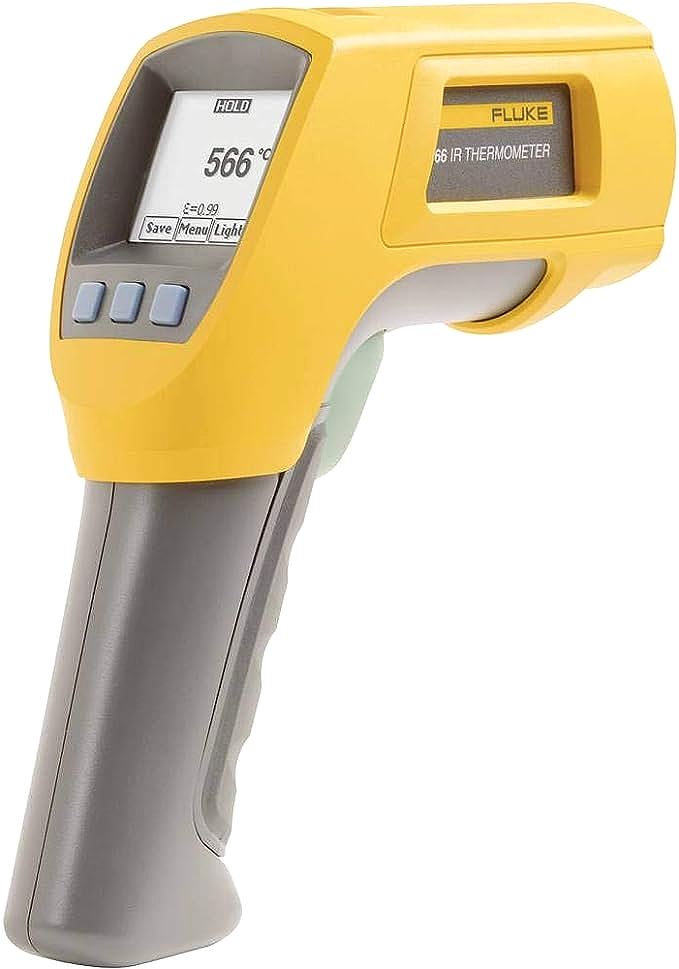
This is why the Fluke 566 is not just an IR gun; it is a Contact Thermometer. By integrating a standard K-type thermocouple input, it acknowledges a fundamental truth of metrology: sometimes, you just have to touch it. This article explores the thermoelectric physics behind contact measurement (the Seebeck Effect), the “Contact Paradox” of thermal resistance, and the strategic workflow of “Scan-Verify” that defines professional diagnostics.
The Physics of Contact: The Seebeck Effect
While infrared thermometry relies on optics and photons, contact thermometry relies on electrons and voltage. The K-type thermocouple supplied with the Fluke 566 is based on a phenomenon discovered in 1821 by Thomas Johann Seebeck.
The Thermoelectric Generator
The Seebeck Effect states that when two dissimilar conductors (metals) are joined at two points to form a loop, and a temperature difference exists between those points, a voltage (electromotive force) is generated. A thermocouple is essentially a tiny battery powered by heat.
In a Type K thermocouple, the two metals are Chromel (90% nickel and 10% chromium) and Alumel (95% nickel, 2% manganese, 2% aluminium, and 1% silicon). When the probe tip (the “hot junction”) touches a warm surface and the connector at the meter (the “cold junction”) remains at room temperature, electrons migrate, creating a measurable voltage potential in the millivolt range.
The Fluke 566 measures this tiny voltage and uses standard reference tables (linearization algorithms) to convert it into a temperature reading. Because this process depends on direct thermal conduction, it is immune to the optical tricks that plague IR sensors. It doesn’t care if the surface is shiny aluminum or matte black paint; the voltage generated is purely a function of the temperature difference.
The Contact Paradox: Thermal Resistance and Response Time
However, contact measurement has its own physics to contend with. The act of measuring temperature changes the temperature.
The Observer Effect
When a cold thermocouple probe touches a hot bearing, heat flows from the bearing to the probe until they reach thermal equilibrium. This heat transfer takes time (response time) and temporarily cools the spot being measured (thermal loading). * Mass Matters: A heavy industrial probe might cool a small transistor significantly, leading to a low reading. The Fluke 566’s bead probe is designed with low thermal mass to minimize this error and ensure rapid equilibrium. * Contact Resistance: The interface between the probe and the surface is never perfect. Microscopic air gaps act as insulators. For precision work, thermal paste is sometimes used, but in general industrial diagnostics, firm pressure is required to minimize this “contact thermal resistance.”
The Strategic Workflow: Scan and Verify
The true power of the Fluke 566 lies in the synergy of its two modes. They are not redundant; they are complementary steps in a rigorous diagnostic logic.
Step 1: The Broad Spectrum Scan (IR)
The workflow begins with the infrared optics. A technician enters a server room or a substation. Using the IR mode, they perform a “thermal sweep.” They scan rows of breaker panels, bus bars, and cooling fans. * Objective: Anomaly Detection. They are looking for Delta-T ($\Delta T$)—temperature differences. Is one phase significantly hotter than the others? Is the return air grille warmer than the supply? * Physics: The 30:1 D:S ratio allows them to stand safely outside the arc flash boundary while resolving individual components. Speed is key here.
Step 2: The Emissivity Check (Cross-Verification)
The technician finds a shiny copper connector that reads 40°C, but suspects it might be hotter due to the low emissivity of copper. This is the “Emissivity Trap.” * Action: They attach the bead thermocouple and touch the copper connector (safely, on a de-energized system, or using an insulated probe). * Result: The contact probe reads 85°C. * Calibration: The technician can now adjust the IR emissivity setting on the Fluke 566 until the IR reading matches the contact reading (e.g., setting $\varepsilon$ to 0.18). Now, the IR gun is “calibrated” for that specific material, allowing for safe, non-contact monitoring of that component in the future.
Step 3: The Core vs. Surface Analysis
In food processing or HVAC, surface temperature is often a lie. A frozen chicken breast might be -10°C on the surface but warmer inside. A liquid line in a refrigeration system needs subcooling measurements of the fluid, not the copper pipe surface. * Action: The contact probe penetrates the medium or clamps firmly to the pipe (under insulation). * Physics: This bypasses the thermal gradient of the object, measuring the thermodynamic core state that dictates safety (pathogen kill kill) or efficiency (phase change).
Data Integrity and Reporting
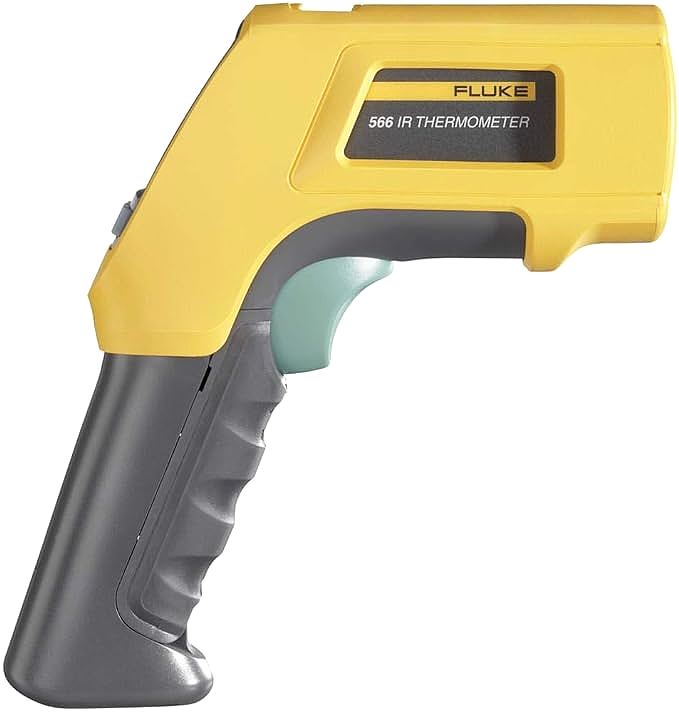
In modern industry, if it wasn’t recorded, it didn’t happen. The Fluke 566 supports data logging of up to 20 points. * The Context of Data: A logged temperature point includes the timestamp and the method (IR or Contact). This context is vital. An IR reading of a steam trap might be logged as “preliminary scan,” while a contact reading is logged as “verified failure.” * Trend Analysis: By consistently logging data from the same points over weeks, predictive maintenance algorithms can detect the slow rise in operating temperature that precedes a catastrophic bearing failure, allowing for scheduled replacement rather than emergency downtime.
Conclusion: The Holistic Thermometer
The Fluke 566 is an acknowledgement that physics is messy. Light reflects, surfaces vary, and heat flows in complex ways. A single sensing technology is rarely enough to capture the whole truth.
By combining the photon-counting speed of infrared with the electron-counting reliability of thermocouples, the Fluke 566 provides a holistic thermal picture. It empowers the technician to be a physicist in the field—navigating the optical illusions of emissivity, overcoming the barriers of distance, and piercing the surface to find the heat that hides beneath. It is a tool not just for measuring temperature, but for verifying reality.